'At one stage, one interviewer asked me to name 3-4 world leaders who had made the biggest impact on the world.' "Our PM, Modiji, of course. I named him first. Then Trump... Later, my father said I should have remembered Gandhi. But what to do, Sir? Mistakes happen.' 'Besides, had not Trump called Modiji the father of our nation?'
'The Modi government has turned the basic fundamentals of its Pakistan policy on its head.' 'It means an admission that its hands-off-Hurriyat policy was flawed and it is ready to engage with Pakistan without minding if the Kashmiri separatists talked to the Pakistani government,' says Rajeev Sharma.

Pakistan is growing restive with the below the radar screen diplomacy. This is the issue Modi and Sharif will grapple with at their Washington meeting, says Rajeev Sharma.
He said the JeM handler, who is in his late 20s, was in the tribal area of Pakistan when he communicated around 18 times with the terrorists.
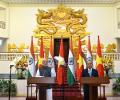
New Delhi is quietly reclaiming its space in Asia by forging alliances with China's neighbours. In a way, India is converting its much-talked about Act East Policy to Engage East practice.

'I want to assure this House that in these talks we have not conceded anything.' Full text of what Defence Minister Rajnath Singh told Parliament on the Chinese pullback in eastern Ladakh.
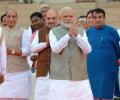
'The Modi Model we see now is still the old Gujarat Model.' 'But with an acknowledgement that governing India is more challenging than governing Gujarat,' notes Shekhar Gupta.
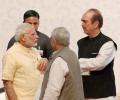
Everything you wanted to know about Prime Minister Narendra Modi but didn't know who to ask. Read on!

'The lack of zeal to serve the country in the mammoth government machinery will be the biggest challenge for Narendra Modi and his government as he tries to change things; there will be not just resistance, but a lack of response to begin with.' If Narendra Modi becomes prime minister, Sheela Bhatt/Rediff.com says the issue of human resources, lack of talent and value system in governance will be his biggest challenge.

The Saudi Arabian diplomat, who was charged with confinement and rape of two Nepalese women, on Wednesday night left the country.
'Advani went by the book, by files, by advice given by his babus. He may be well read and articulate and a pleasant conversationalist, but none of that makes for the kind of creative politician that Vajpayee was.' 'This is the kind of observation about the Vajpayee premiership, more than the promise of espionage or Kashmir gossip, that made writing A S Dulat's book a satisfying experience,' says Aditya Sinha.
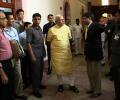
The Modi PMO is like none other: It is staffed by people who are so low profile that the only dominant personality is the Prime Minister's.
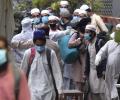
Sheela Bhatt narrates the behind-the-scenes action in the Delhi headquarters of Tablighi Jamaat that finally forced the religious sect's compliance with the coronavirus shutdown.

Since the change in administration in the US, Indian leaders have publicly and privately identified with American objectives in Afghanistan.
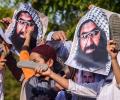
'Jaish e Mohammed has been allowed to resurge through supported terror actions in J&K in a deliberate tactic by Pakistan, if only to reduce the international pressure on the Lashkar e Taiba leadership after 26/11,' points out Rana Banerji, who headed the Pakistan desk at the Research and Analysis Wing, India's external intelligence agency.

Pakistan has been consistently saying that Dawood is not living in Pakistan
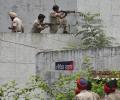
Seven people, including two police officers and a terrorist, were killed as the Punjab Police's elite Special Weapons and Tactics team and the Indian Army were carrying out a massive operation in the Gurdaspur district to flush out terrorists who went on a rampage attacking a bus and a police station complex.

Dai Bingguo, who served as the China's boundary negotiator with India from 2003 to 2013, told Chinese media, "If the Indian side takes care of China's concerns in the eastern sector of their border, the Chinese side will respond accordingly and address India's concerns elsewhere."

A group of former senior military and civil services officers has asked the government to cancel the proposed talks between the Prime Ministers of India and Pakistan in New York next month in view of unabated Pakistan-inspired terrorism against this country.

In his hunger for power, the prime minister has forgotten raj dharma, the Congress alleged.
Home Minister Rajnath Singh on Friday chaired a meeting on internal security, which was attended by Defence Minister Manohar Parrikar and National Security Advisor Ajit Doval.
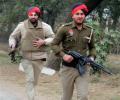
'Had this been handled in a correct way, the only lives that would have been lost, presumably, were the lives of the terrorists and that would have been welcome.' The information we had was pure gold. You seldom get information of this kind several hours in advance, exactly where they are going to strike. But we still couldn't act on this intelligence.'

The Afghan deputy foreign minister explains how his nation's President became disillusioned with Pakistan. Ajai Shukla listens in.

So, how does Pompeo's check list look like? In a broad sense, he is coming here 'to make sure that we have economic openness'; to ensure that 'we have to deliver'; to understand that 'we have to execute' what we promised to do; and, to 'broach some tough topics', points out Ambassador M K Bhadrakumar.

'Tibet remains a prickly issue between the giant Asian nations. China still claims more than 80,000 sq kilometres of Indian territory in the Northeast. Why? Just because Beijing refuses to acknowledge the McMahon line which separates India and Tibet, and this, simply because the 1914 Agreement delineating the border was signed by the then government of independent Tibet with India's then foreign secretary (Sir Henry McMahon),' says Claude Arpi.
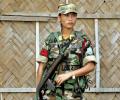
Naga rebel groups remain divided over the pact. Moreover, secrecy on accord creates apprehension in the society. K Anurag reports

'War cannot resolve problems. So wisdom is to resolve diplomatically.'

'A couple of hours before the H-Hour, the Kupwara division opened small arms and mortar fire on posts opposite its area of operation.' 'This was a diversionary tactic.' 'As Pakistani forces began to react to the firing, special forces teams began to slowly cross the LoC into PoK.' Nitin Gokhale reveals how planning for the surgical strikes began hours after the Uri attack.

India must present its demands of America confidently, instead of fearing that its pocket will somehow be picked, says Ajai Shukla.
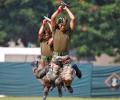
'Not a single soldier should be left behind in enemy territory.' Nitin A Gokhale's fascinating account on how the Indian Army conducted the daring and successful cross-border operation last September.

'Modi wants to be pragmatic -- acknowledge the problem of Pakistan and that full reconciliation is essentially a non-starter, but at the same time grab the low-hanging fruits (such as trade) to put things on a more even keel, to engender enough stability in the relationship to allow him to focus on other priorities.'

'Why can't a person who has supervised military intelligence head RA&W?' 'Why can't one who has overseen national security planning become our NSA or chair the National Security Advisory Board?' asks Vice Admiral Premvir Das (retd).

'This is what we train for: That one chance to deliver a blow so lethal that the enemy will constantly think about it when planning any misadventure.'

'Engagement should never stop.' 'Reassure Kashmiris that they will be treated at par with the rest of India.' 'The peace you crave will be peace with honour.' 'Your special status will not be tinkered with.'

'Washington is telegraphing here is its willingness to support a low-grade, limited use of force meant to send a strong message to Pakistan.' 'Perhaps something along the lines of the surgical strikes in 2016, or perhaps something a bit more -- but not much more.'

Aziz Haniffa, who has covered every Indian Prime Minister's visit to the US since Rajiv Gandhi in 1985, gives us a peek into what's happening in Washington, DC on the eve of the Modi-Trump summit.

The outcome of the Bangkok NSA-level talks underscores that Pakistan has got exactly what it wanted -- talks at different levels, talks on Kashmir, talks on mutual concerns regarding terrorism, talks on ceasefire on the border. What if any has been India's gains remains unexplained, says Ambassador M K Bhadrakumar.
Who are the men the prime minister relies on to execute his impressive agenda?

While the Rafale deal seems to be the main order of business during French President Francois Hollande's visit, other aspects could help sweeten the deal, says Claude Arpi.
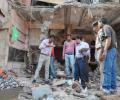
If terror indeed has no religion, no partisan affiliations, and if the government, media and all right-minded people in this country people truly believe that, let us not call one blast a "terrorist incident" and dismiss another one as a mere "cylinder blast" just because it is politically convenient, says Shehzad Poonawala.'If terror indeed has no religion, no partisan affiliations, and if the government, media and all right-minded people in this country truly believe that, let us not call one blast a "terrorist incident" and dismiss another one as a mere "cylinder blast" just because it is politically convenient,' argues Shehzad Poonawalla.
